Interview
Zihua Mo
Zihua Mo, United States
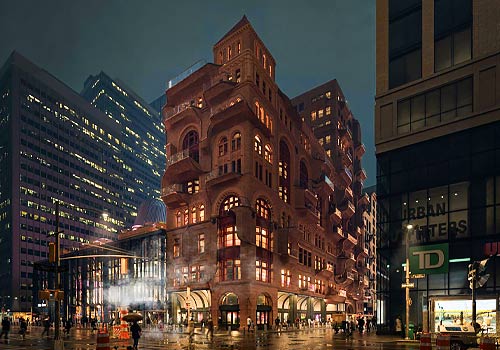
Zihua Mo’s work on the Corbin Building rebuilds connection through space, food, and communal memory, responding to a world where people often feel distanced from one another. He combines practical technique with bold vision, aiming for designs that stay honest, grounded, and future-minded.
1 | Congratulations on your achievement! What inspired you to submit this project for the NY Architectural & Interior Design Awards?
After finishing the design, I felt a kind of solitude. First, I wanted to understand—if I placed this work on a global stage, how would it stand among others? I needed that external validation. Second, I hoped to find a platform to share a project I was truly proud of, rather than letting it stay unseen in my portfolio.
2 | What is the defining concept or vision behind your award-winning project?
This project is rooted in the cultural and physical fabric of New York City. Against the global backdrop of growing isolation and de-globalization, it seeks to rediscover shared human language—through space, food, and collective experience. As an adaptive reuse project, it employs an unconventional design strategy—grounded in the existing building’s language yet evolving into a new, futuristic form of its own. The architecture, in its graceful posture, becomes a poetic gesture toward a better life.
3 | Could you briefly share your journey into architecture and what inspired you to pursue this field?
I grew up in China, always fascinated by making things with my hands, by art, music, and creative expression. When I first discovered architecture in high school, it felt like the perfect balance between imagination and practicality. However, within China’s rigid education system, I couldn’t major in architecture at the undergraduate level and instead studied Urban and Rural Planning. Still, I constantly joined student architecture competitions alongside architecture students. Later, I learned that U.S. graduate programs accepted students from non-architecture backgrounds. I applied and was admitted to the University of Pennsylvania’s M.Arch program—known for its bold aesthetics and technical rigor. After graduation, despite a challenging economy and widespread career shifts, I continued firmly on the path of architectural design.
4 | How would you describe the mission or goals of your company or studio?
In a world dominated by fast trends and short attention spans, our goal is to preserve a sense of integrity—to create designs that are neither trendy nor superficial. We aim to meet every basic need elegantly, push imagination courageously, and realize ambitious visions through advanced, technically sound means.
5 | Were there any unexpected challenges during the design or construction phases? How did they shape the final result?
At the beginning, digitally reconstructing the Corbin Building proved far more complex than expected. Unlike many modern façades composed of modular repetition, the Corbin Building changes character as it rises—each level has different window types, proportions, and ornamentation. The intricate reliefs and decorations made the digitization process painstaking. Yet through that process, I was, in a sense, learning across time from architects of over a century ago. Studying the historic façade inspired me to respond with a contemporary language—clean yet non-linear, respectful yet original, rejecting mere replication.
6 | How does your design process usually unfold-from ideation to completion?
A balanced design comes from mastering both the ordinary and the cutting-edge—from understanding the most common methods to the most advanced. Only then can you find equilibrium among countless real-world constraints, making just the right compromises while still realizing an ideal vision.
7 | If you had to describe the journey of this project in three words, what would they be?
Exploration, Dedication and Fulfillment.
8 | What feedback have you received about your work that has been particularly meaningful or surprising?
Many people said the exterior looked beautiful—but what surprised me most was that, upon seeing the interior, several remarked that it felt so engaging and livable that they would love to live there. That kind of feedback reassured me that my design values truly resonate—that architecture can indeed communicate emotion and possibility.
9 | What does receiving this recognition mean for you, your team, or your studio?
It feels like a beautiful medal for the project—recognition of both its ideas and execution. I’m also genuinely happy to have my work exhibited alongside so many other remarkable projects from around the world.
10 | How do you see this award influencing your future projects or career?
At times when I question my own abilities or the quality of my work, this award serves as strong encouragement. It reinforces my belief in the project’s values and motivates me to continue creating designs that are innovative, impactful, and oriented toward a better everyday life.
11 | What's a project or idea you've been dreaming of bringing to life, and why does it inspire you?
I dream of creating a project that is bold yet refined, innovative yet deeply humane—one that elevates daily life. Without boldness, design becomes mediocre; without beauty and precision, it lacks discipline. And without serving life, it risks becoming a hollow sculpture detached from reality.
12 | Where do you see the architectural field heading in the next decade, and how do you envision contributing to its evolution?
The next era of architecture will be defined by collaboration with AI—broader imagination, faster iteration, and more intelligent decision-making. Aesthetically, architecture will grow increasingly hybrid and collage-like, while socially it will shoulder greater responsibility for sustainability. Eco-friendly materials, efficient structures, and low-impact construction methods will replace outdated ones. The age of heroic, large-scale development will give way to smaller, more refined interventions and thoughtful adaptive reuse. I hope to contribute to this evolution through creative yet responsible design.
13 | How do you see your designs contributing to the future of sustainable architecture?
This project itself is a form of sustainability—it’s an adaptive reuse approach that revitalizes an old façade and reactivates underused urban spaces, instead of demolishing and rebuilding from scratch. The new additions employ terra-cotta cladding, a natural, durable, and sustainable material. Moreover, the proposed shared living model promotes resource efficiency and social sustainability by encouraging community and reducing redundancy.
14 | If you could design anything, with no limits on budget or imagination, what would it be?
I would design something the world has never seen before—an architecture that transcends imagination, just as Zaha Hadid, Enric Miralles, and Antoni Gaudí once did. Something visionary, poetic, and entirely unexpected.