Interview
Patricia Cunha
ImpactPlan Art Productions, Portugal
Patricia Cunha is the Creative Director and Founder of Impactplan Art Productions, where she leads large-scale public art projects that use color as a powerful tool for communication, social impact, and human connection. Today, through ImpactPlan, she continues to transform everyday urban spaces into meaningful shared experiences, guided by creativity, community engagement, and an increasing focus on sustainable practices.
1 | Congratulations on your achievement! What inspired you to submit this project for the NY Architectural & Interior Design Awards?
We submitted this project in the Cultural Architecture category because it represents a deep dialogue between Chaves’ historical legacy and contemporary design. Our installation draws directly from the city’s architectural culture, its Roman geometry, medieval textures, and modern identity, reinterpreting these elements into an unforgettable public art experience. The NY Architectural Design Awards felt like the ideal platform to highlight how cultural heritage can inspire new forms of urban expression, and how art has the power to revitalize a city, bringing new life, pride, and connection to its public spaces.
2 | What is the defining concept or vision behind your award-winning project?
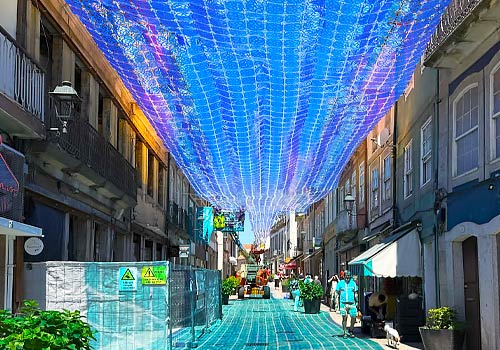
The defining concept of this project is the idea of weaving past and future together, using culture as the bridge that connects heritage with innovation. We wanted to show how the identity of Chaves, rooted in centuries of architectural and symbolic history, could become the catalyst for a renewed urban experience and a revitalized commercial district. Drawing from the city’s iconography, from its Roman foundations to its medieval and contemporary history, we created three interconnected installations: Layers, inspired by the movement of the Tâmega River; the Magic Carpet, with its 8,820 iridescent squares reflecting the municipality’s new visual identity; and the Cubes, a reinterpretation of local patterns and symbols transformed into floating geometric forms. These elements collectively transformed the historic center into an open-air museum. But beyond aesthetics, the project had a strategic purpose: to energize local commerce and welcome it into a new age through culture. By creating visually captivating spaces that attract visitors, encourage exploration, and stimulate social media sharing, the installation strengthened the “Bairro Comercial Digital” initiative—bringing foot traffic, visibility, and renewed pride to the shops and artisans of Chaves. Culture became the connector: honoring the past while supporting economic vitality and guiding the city confidently into its digitally enhanced future.
3 | Could you briefly share your journey into architecture and what inspired you to pursue this field?
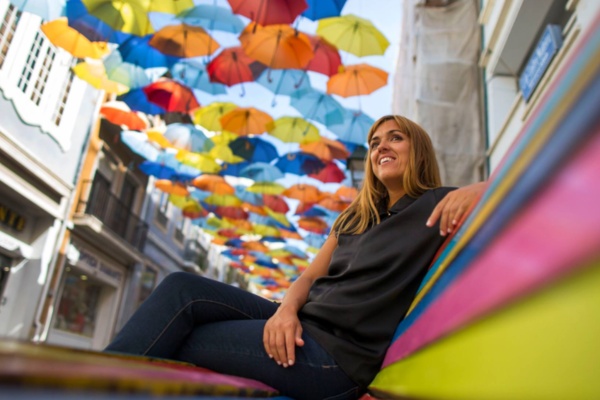
My journey didn’t begin in architecture but in the world of creativity and visual storytelling. I studied Marketing and Advertising and initially worked in the fashion industry, helping to develop several clothing brands. But around 2009, I discovered my true calling when I began creating small artistic interventions in public spaces—dressing trees, painting benches, and transforming staircases. Those early experiments opened the door to a new way of expressing myself: through large-scale, immersive art installations that interact directly with the public. What began as simple gestures evolved into vibrant sky installations, including the internationally recognized Umbrella Sky Project. Its success inspired me to co-found Impactplan Art Productions with Bruno Almeida, forming a collective dedicated to spreading color, joy, and human connection across cities worldwide. Today, my work—including projects like Color Rain, Tropicália, and Bubble Sky—continues to explore color as a universal language capable of transforming spaces and inspiring community. That passion for uplifting people and cities through public art is what ultimately led me to this field and continues to drive every project I create.
4 | How would you describe the mission or goals of your company or studio?
At Impactplan, our mission is to transform the ordinary into the extraordinary through color, creativity, and community engagement. Our work begins with a simple intention: to bring color to grey landscapes. By using vibrant palettes and unexpected materials in surprising places, we create installations that spark emotion, curiosity, and connection. Each project is designed to uplift public space while honoring its local identity. As we continue to grow, sustainability has become a central part of our vision—developing future projects with environmentally friendly materials, and prioritizing recycling and reuse. We transform ideas into bold, memorable, and highly shareable art installations that have real impact, both visually and socially. Our goal is to inspire a global movement of color and positivity. We invite people everywhere to join us—because together, we truly can color life and make the world a brighter, better place.
5 | Were there any unexpected challenges during the design or construction phases? How did they shape the final result?
Although we have developed our own innovative method to make our installations portable and efficient to assemble, each city brings new challenges. In Chaves, adapting our system to the constraints of a historic center—its protected façades, narrow streets, and strict regulations—required careful adjustment. Installing hundreds of pieces without disturbing residents or local commerce pushed us to refine our approach on-site. These challenges ultimately strengthened the project, making it more resilient and even more harmoniously integrated into the heritage environment.
6 | How does your design process usually unfold-from ideation to completion?
Our design process always begins with immersion and research. We take time to understand the history, necessities, and identity of a place. In Chaves, this stage was particularly meaningful because we were entrusted with creating a new visual identity for the city, honoring its Roman heritage, its connection to water, and the cultural symbols that define it. It was both an honor and a profound responsibility. From there, our multidisciplinary team steps in. Our designers develop the visual language, our product designers refine structural behavior, prototype and test each element to ensure it performs beautifully in real-world conditions. Once all of that is finalized, the production team brings it to life with the help of local artisans, and our installation crew works on-site, adapting to each location’s specific constraints and opportunities. Every phase, made by humans.
7 | If you had to describe the journey of this project in three words, what would they be?
Culture, water and connection.
8 | What feedback have you received about your work that has been particularly meaningful or surprising?
The most meaningful feedback came from residents who told us the installation made them feel proud of their city. Hearing that people changed their daily routes just to walk under the colors or that shop owners saw renewed energy in the streets confirmed that our work had a real impact.
9 | What does receiving this recognition mean for you, your team, or your studio?
It’s an affirmation of the value of public art installations and community-centered art. For our team, it is a celebration of countless hours of design, craftsmanship, and onsite collaboration. And for the city of Chaves, it shines an international light on their city and culture, validating the bold investment they made in art as a catalyst for revitalization, identity, and pride.
10 | How do you see this award influencing your future projects or career?
This award reinforces that we are moving in the right direction and that our approach to public art, rooted in color, handcraft, and community, is meaningful and valued. It gives us the confidence to keep pushing boundaries, exploring new materials and scales, and deepening our engagement with cities around the world. The recognition also opens doors for new collaborations and encourages more municipalities to invest in art as a powerful tool for identity and revitalization. Above all, it inspires us to continue creating work that brings joy, connection, and purpose to the places we touch.
11 | What's a project or idea you've been dreaming of bringing to life, and why does it inspire you?
I dream of creating a flagship creative campus that celebrates human imagination and connection. A vibrant, color-driven space that would host workshops, studios, multisensory playgrounds, and immersive art experiences, open and free to all. This project inspires me because it proves that creativity is limitless, inclusive, and capable of transforming communities.
12 | Where do you see the architectural field heading in the next decade, and how do you envision contributing to its evolution?
Architecture is moving toward human-centered, culturally rooted, and environmentally responsive design. Cities are rediscovering the value of public space as a platform for connection and identity. I see our work contributing by bringing art into architecture—creating installations that honor heritage, foster participation, and activate the public realm in sustainable and emotionally resonant ways.
13 | How do you see your designs contributing to the future of sustainable architecture?
We focus on lightweight, low-impact interventions that transform spaces without heavy construction. Because our installations are ephemeral, we prioritize sustainability through reuse, repurposing, and continuous material innovation rather than permanence. Many elements are designed to be disassembled and given a second life, and can be donated to local institutions. Our work is also handmade by our team and local artisans, which allows us to reduce energy consumption, support local economies, and help keep traditional skills alive. By producing locally and crafting by hand, we minimize transportation impact and maintain a more human, sustainable pace of creation.
14 | If you could design anything, with no limits on budget or imagination, what would it be?
If I could design anything with no limits, I’d create a flagship destination dedicated to human creativity and connection, a large-scale, color-driven creative campus fully integrated with nature. At its heart, a vast garden would anchor the project, surrounded by immersive corridors of color, and a transparent roof that keeps the sky as part of the experience, music rooms, meditation zones, a hobby library, exhibition spaces, and unexpected art interventions that challenge perception. It would operate as a living ecosystem of ideas: workshops happening daily, maker-rooms equipped with tools for building and experimenting, library, painting studios, creative-cooking labs, physical activity spaces, and sewing rooms. A large multisensory playground with playful activities would invite people of every age to explore, touch, learn, and imagine. Elevated walkways would allow visitors to observe what’s happening in each area, turning the entire space into a dynamic stage of creativity in action. Most importantly, it would be completely free and open to everyone. No barriers. No exclusions. A public investment in imagination designed to unlock human potential and prove that creativity is a renewable resource capable of transforming communities and economies.