2026 | Professional

Coexisting with Water: Energy-Equitable Vertical Living
Entrant
University of Michigan, Ann Arbor
Category
Student Design - Urban Design and Planning
Client's Name
Hui-Cheng Chung
Country / Region
United States
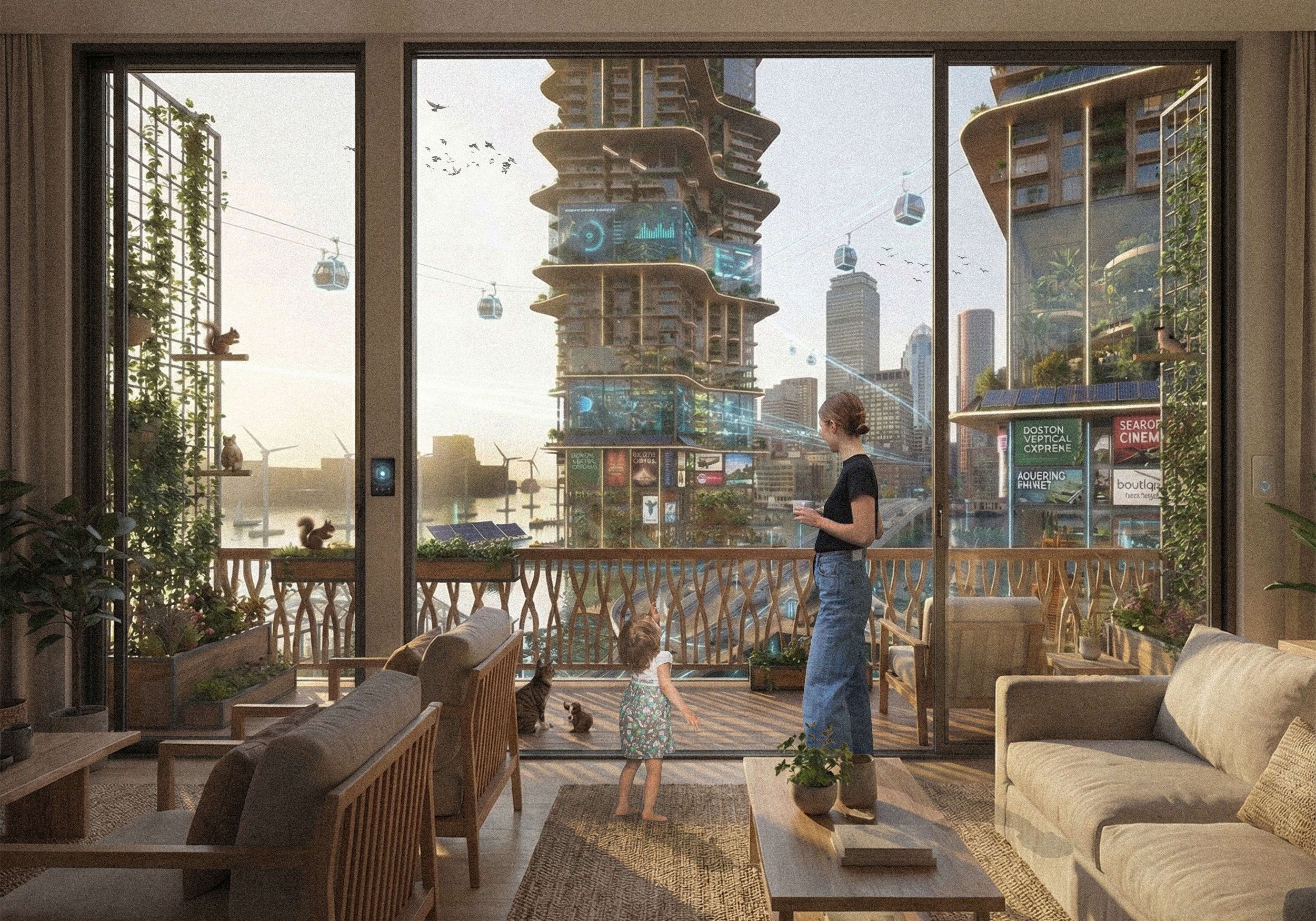
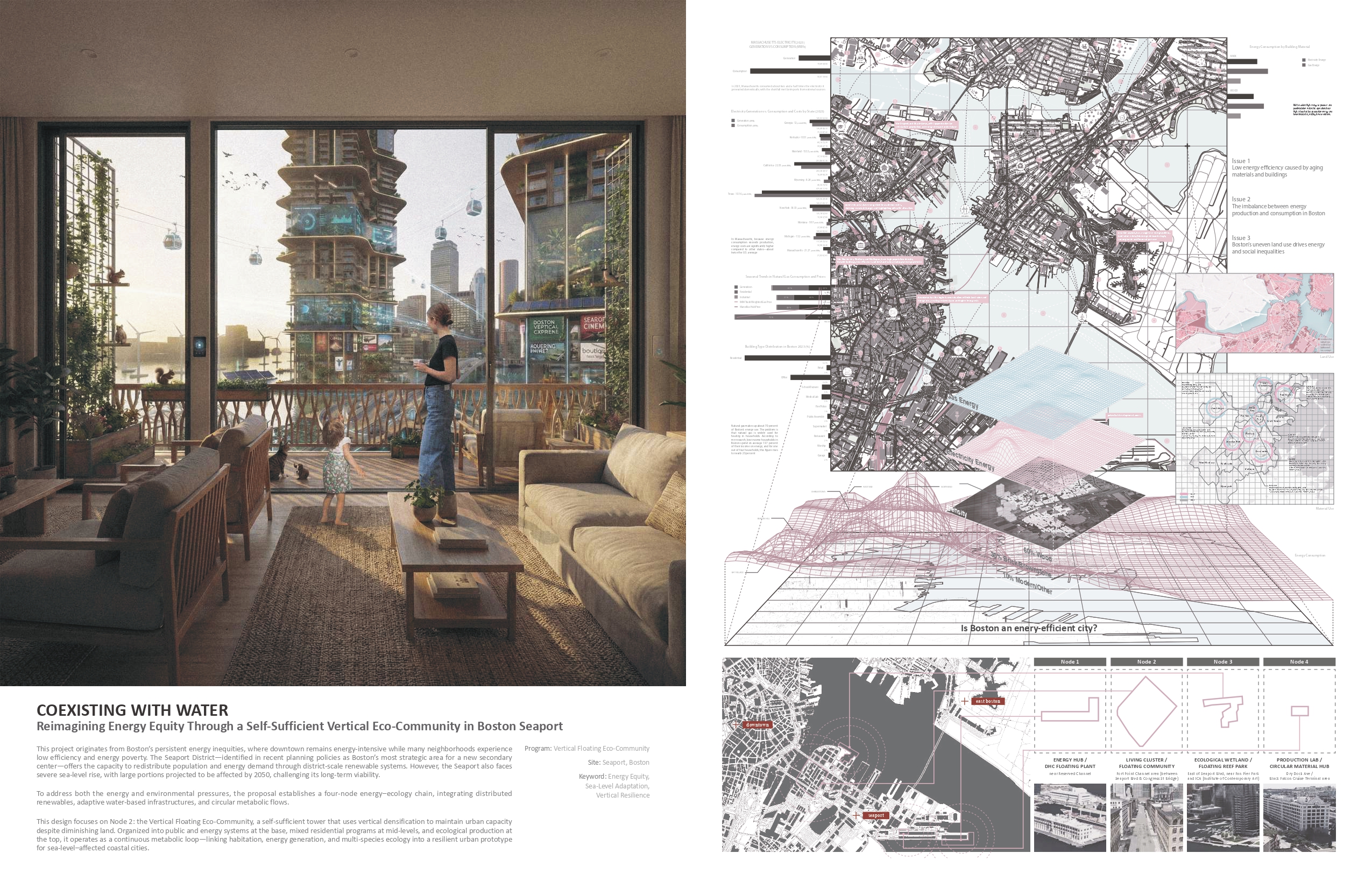
Boston faces growing spatial and energy disparities: dense, energy-intensive downtown areas contrast with older neighborhoods suffering from inefficiency and energy poverty. The city’s centralized energy systems constrain resilience, highlighting the need for decentralized, adaptive strategies. This project proposes a self-sufficient vertical eco-community in the Seaport District, integrating distributed renewable energy, smart microgrids, and adaptive urban living systems.
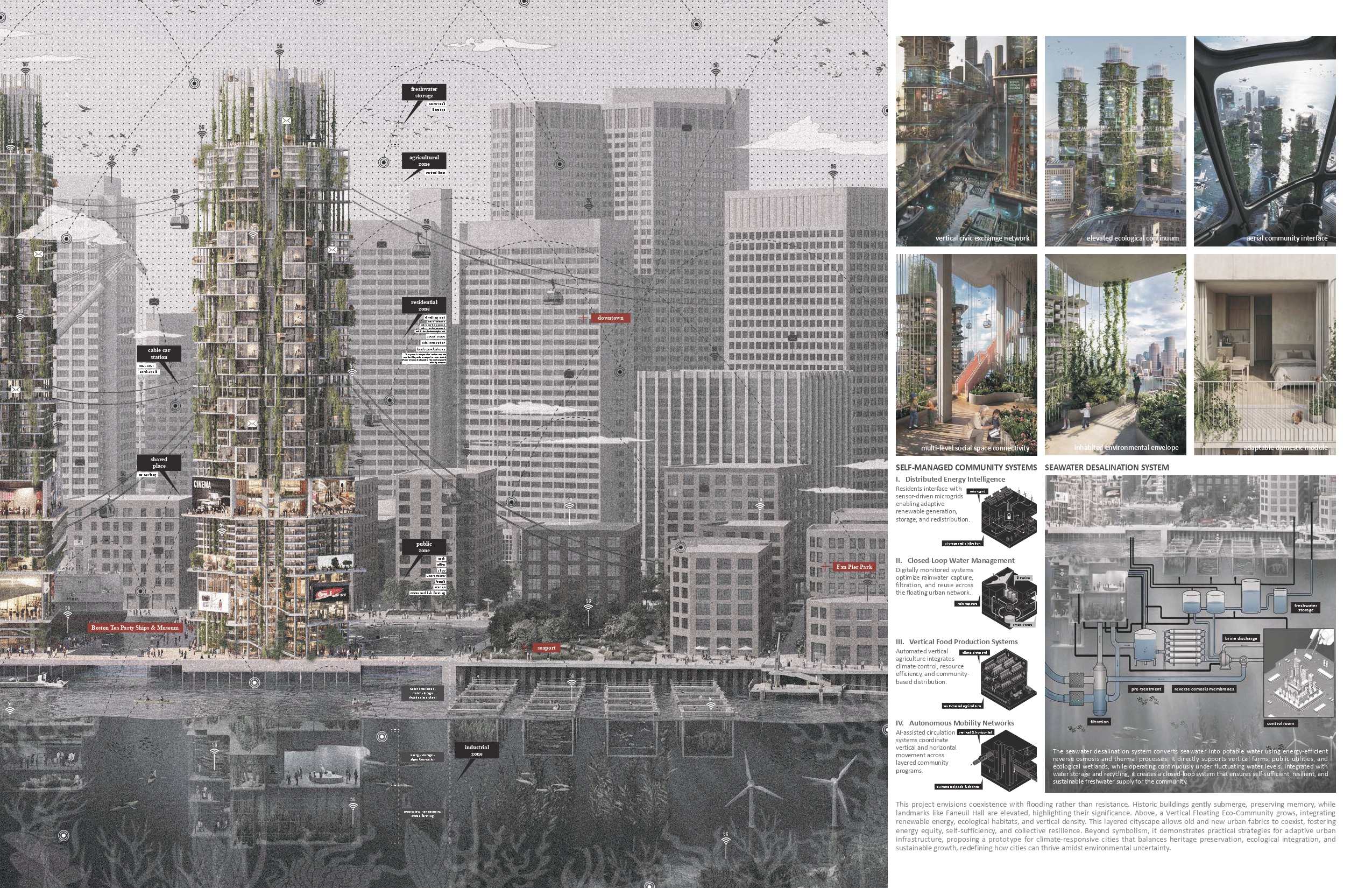
Positioning the Seaport as a secondary urban center, the design redistributes population and energy demand while leveraging district heating and cooling sourced from port waste heat, solar, wind, and seawater heat pumps. A resilient microgrid enables islanding during outages, forming a flexible, decentralized energy loop. Anticipating sea-level rise, the community adopts floating and amphibious structures, adaptive wetlands, and energy systems designed to function under fluctuating water levels.
The district is structured into four metabolic nodes: an Innovation Energy Zone—a semi-submersible renewable power station; a Floating Vertical Eco-Community—a self-sufficient residential prototype; an Ecological & Educational Hub—restoring marine biodiversity and providing public education; and a Circular Material Lab—transforming biomass into construction materials. Together, these nodes establish a self-regulating urban metabolism that balances energy production, ecological systems, and human activity through real-time smart controls.
Focusing on the Vertical Floating Eco-Community, the design accommodates rising population and limited land by building vertically above water, aligning with Boston’s skyline. The tower is layered: a base of public programs, energy infrastructure, and aquatic ecology; a middle of residential units, shared amenities, and ecological terraces; and a top of vertical farms, water storage, and airborne habitats. Energy, water, and biomass circulate continuously, achieving full self-sufficiency.
By embracing coexistence with water, the project integrates Boston’s historic and new urban fabric: partially submerged older buildings preserve memory, while key landmarks and floating towers rise above water. This Vertical Floating Eco-Community demonstrates a model of resilient urban living that combines energy equity, ecological integration, and adaptive density, envisioning a sustainable, water-resilient future for the city.
Credits
Entrant
Canal Street Lab
Category
Interior Design - Living Spaces
Entrant
Taiwan Order Furniture Corporation
Category
Interior Design - Residential
Entrant
Homify Engineering & Design Company Limited
Category
Interior Design - Educational Play Spaces
Entrant
China University of Technology
Category
Student Design - Interior Design