2026 | Professional

Doughnuts, The Industrial-Domestic Continuum
Entrant
Harvard Graduate School of Design
Category
Student Design - Residential Architecture
Client's Name
Country / Region
United States
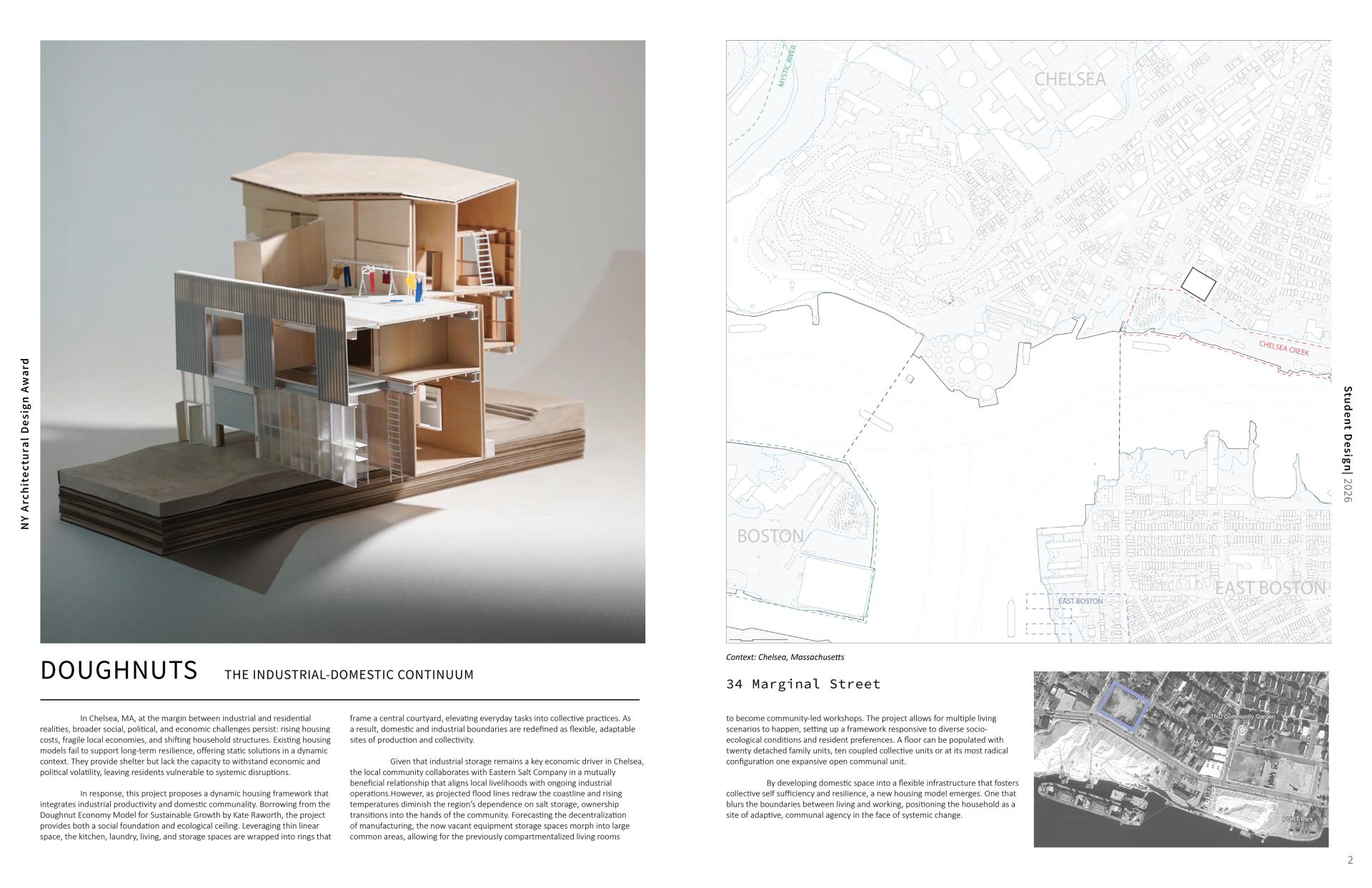
In Chelsea, MA, at the margin between industrial and residential realities, broader social, political, and economic challenges persist: rising housing costs, fragile local economies, and shifting household structures. Existing housing models fail to support long-term resilience, offering static solutions in a dynamic context. They provide shelter but lack the capacity to withstand economic and political volatility, leaving residents vulnerable to systemic disruptions.
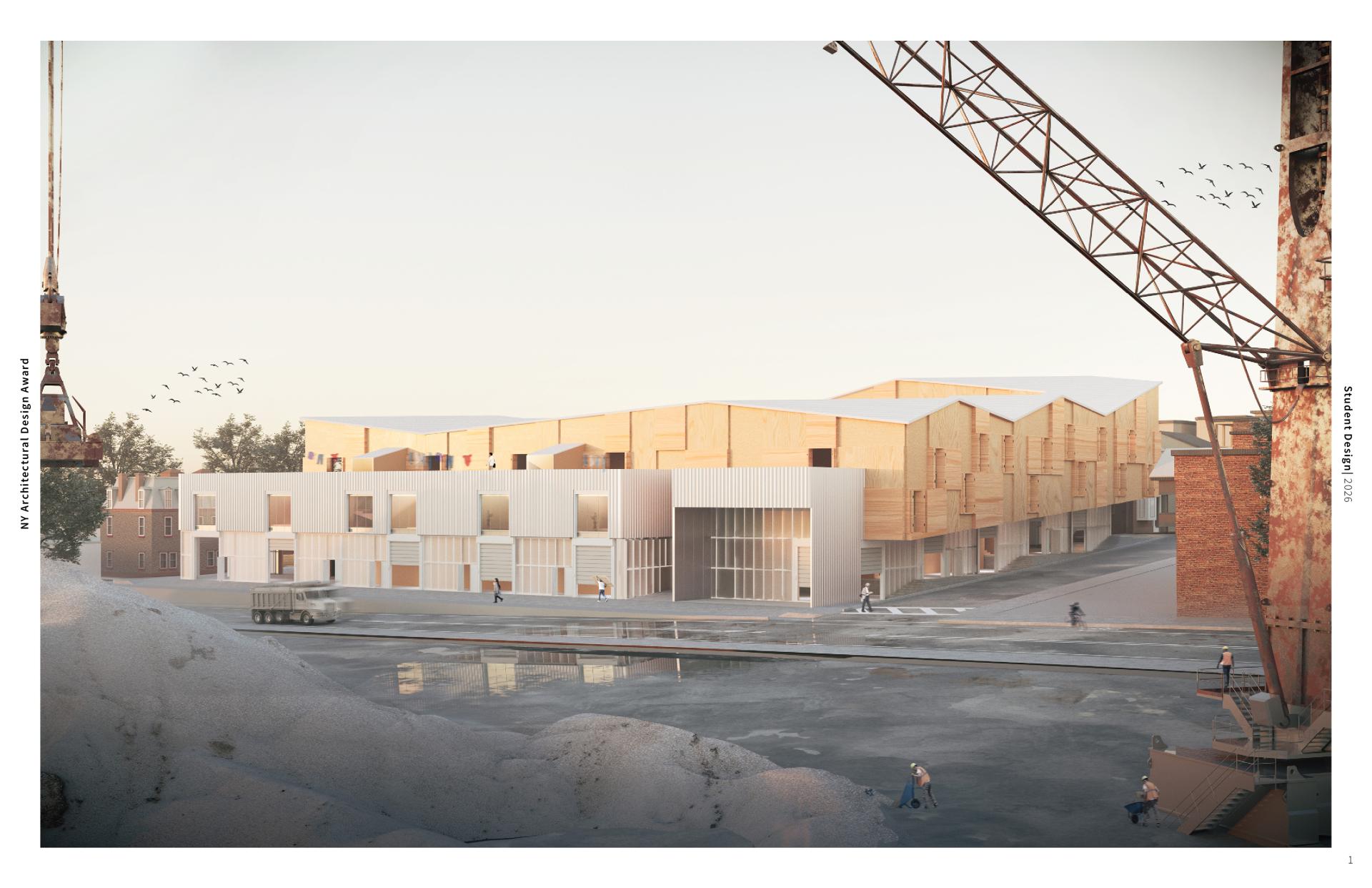
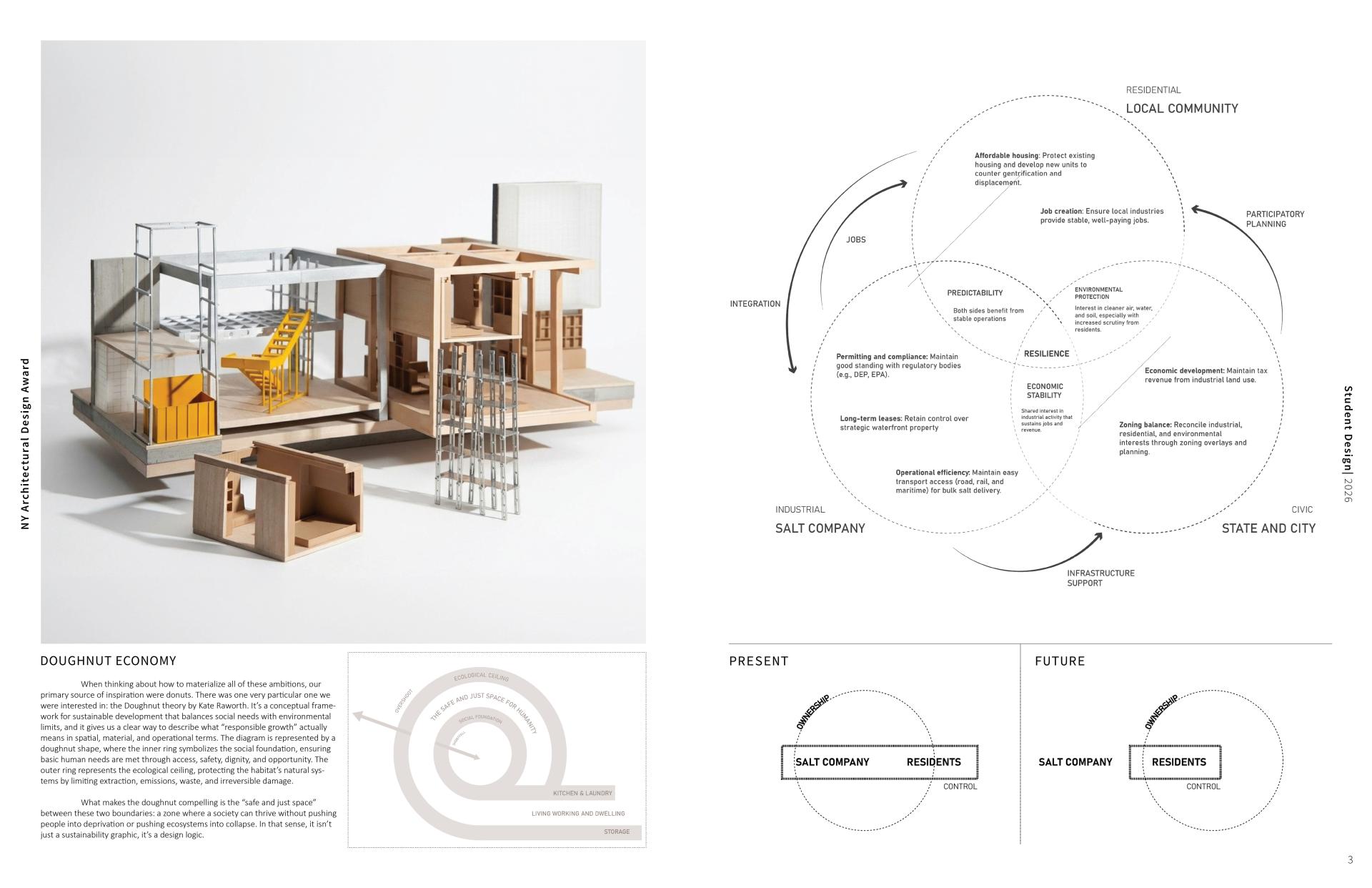
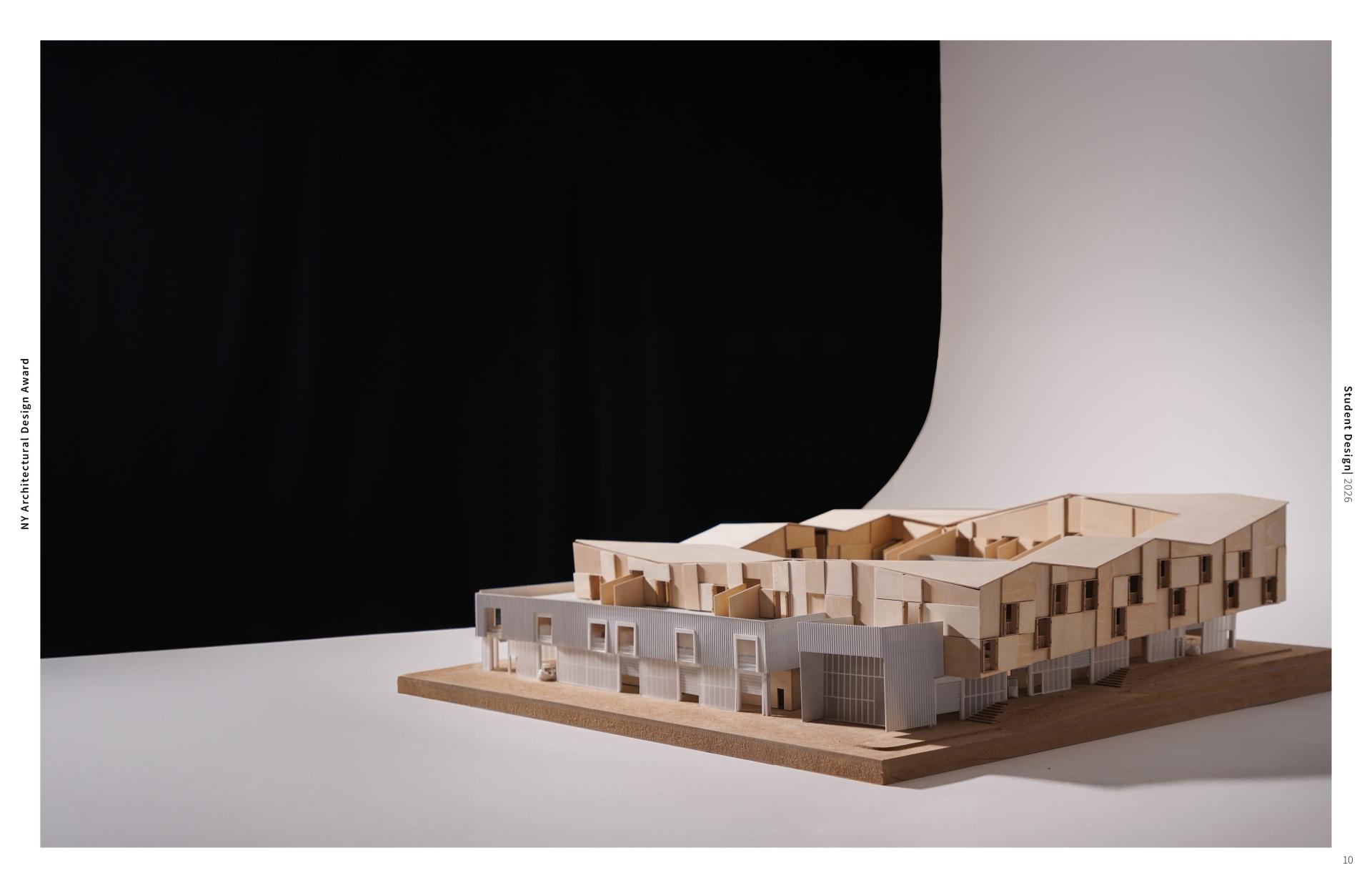
In response, this project proposes a dynamic housing framework that integrates industrial productivity and domestic communality. Borrowing from the Doughnut Economy Model for Sustainable Growth by Kate Raworth, the project provides both a social foundation and ecological ceiling. Leveraging thin linear space, the kitchen, laundry, living, and storage spaces are wrapped into rings that frame a central courtyard, elevating everyday tasks into collective practices. As a result, domestic and industrial boundaries are redefined as flexible, adaptable sites of production and collectivity.
Given that industrial storage remains a key economic driver in Chelsea, the local community collaborates with Eastern Salt Company in a mutually beneficial relationship that aligns local livelihoods with ongoing industrial operations.However, as projected flood lines redraw the coastline and rising temperatures diminish the region’s dependence on salt storage, ownership transitions into the hands of the community. Forecasting the decentralization of manufacturing, the now vacant equipment storage spaces morph into large common areas, allowing for the previously compartmentalized living rooms to become community-led workshops. The project allows for multiple living scenarios to happen, setting up a framework responsive to diverse socio-ecological conditions and resident preferences. A floor can be populated with twenty detached family units, ten coupled collective units or at its most radical configuration one expansive open communal unit.
By developing domestic space into a flexible infrastructure that fosters collective self sufficiency and resilience, a new housing model emerges. One that blurs the boundaries between living and working, positioning the household as a site of adaptive, communal agency in the face of systemic change.
Credits
Entrant
BROISSIN
Category
Cultural Architecture - Interactive and Experiential Spaces
Entrant
Jiang Qiuyu
Category
Student Design - Cultural Architecture
Entrant
Mooooi Studio
Category
Interior Design - Showroom / Exhibit
Entrant
DOME+Partners
Category
Residential Architecture - Multi-Family and Apartment Buildings